|
Tahoe Nugget #83:
Digging Deeper than the Donners June 14, 2006
A $6 million museum has been approved for Donner Lake Memorial State Park, so this summer California State Park archaeologists, overseen by a Chico
State professor, will conduct a dig in the area where the new museum is to be constructed. Although the location is on the path between two of the three cabins built in November 1846 by members of the Donner party,
this excavation project is focused primarily on finding artifacts and remants of Native Americans. Scientists have previously found evidence that people have been crossing Donner Pass for at least 6,000 years, and
"possibly to the mammoth hunters of 11,000 years ago."
Previous digs at one of the cabin sites revealed many Donner party artifacts such as ceramic shards, jewelry and other miscellaneous items. A
pioneer monument was erected over a second cabin location in the early 20th century which has so far stymied efforts for a scientific exploration there. Over the years, souvenir hunters and amateur archaeologists
have looted the site (located close to old Highway 40 and the first transcontinental railroad), but this summer's dig may still unearth additional Donner relics. More exciting would be the discovery of evidence from
the Elisha Stephens-led wagon train of 1844, the first pioneers to haul wagons over Donner Pass and open the California Trail.
Frank X. Mullen, a Donner party historian and senior journalist for the Reno
Gazette-Journal, reported that in the deeper layers of the soil, archaeologists "may find artifacts from the Washoe people (who wintered in present-day Western Nevada), the tribes who preceded them, and other
humans who crisscrossed Donner Pass thousands of years ago. Previous digs have unearthed Washoe ovens, projectile points — spear and arrow tips — that go back at least 6,000 years."
I'll keep you posted.
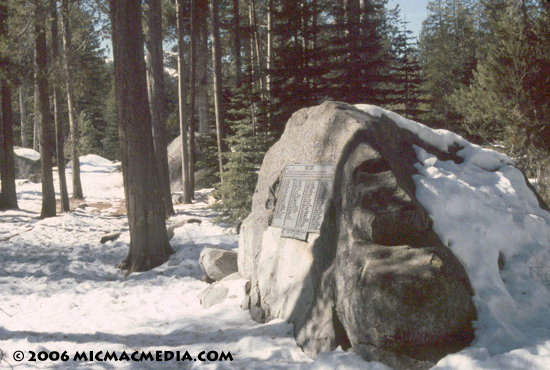
Photo #1: This boulder (glacial erratic) near the east end of Donner Lake served as the west wall of the Murphy family cabin during the heavy winter of
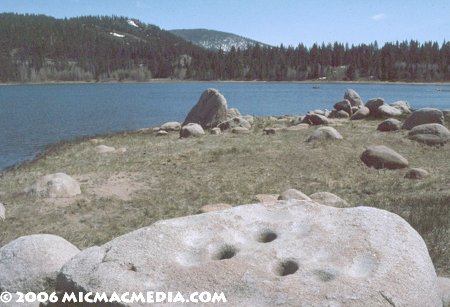
1847. Archaeological digs conducted here in the 1980s and 1990s produced artifacts and animal bones but no evidence of human cannibalism. Photo #2: Indian "metates" at Spooner Lake. A metate is a
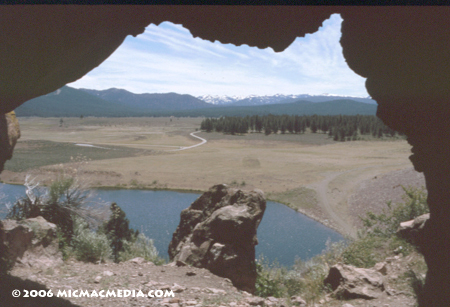
shallow grinding bowl in which nuts and seeds were ground by milling with a small stone held in the hand. Photo #3: American Indians probably used this cave overlooking Martis Valley to rest, spot game or take
shelter from the weather.

|