|
Tahoe Nugget #87:
Lightning Awareness Week
June 26, 2006
Last week the National Weather Service focused on the dangers of thunderstorms with its Lightning Awareness Week. This public education program was well-timed as severe thunderstorms over the past week have
pounded many regions of the country including Texas, the Mid-West, and the Middle Atlantic states.
Although thunderstorm-induced flash floods are the top weather-related killer in the United States
(especially in the arid west where normally dry canyons, gullies, and stream beds can suddenly fill with raging torrents of muddy water spawned by distant storms), fatal lightning strikes kill about 70 Americans
each year.
To avoid becoming a grim statistic, the NWS suggests that at the first sign of lightning always seek a fully enclosed building, preferably with wiring and plumbing; or a hard-topped car or truck.
Partially enclosed carports, covered patios, and tents are NOT safe shelters. Hikers should get off exposed mountain ridges and boaters should get off the water immediately; people outdoors should never stand under
a tree. If you are exposed and there is no safe refuge, squat down with your feet together, cover your ears and close your eyes [and kiss your butt good-bye — just kidding folks]. Lean forward with your heels
off the ground to minimize contact with the ground.
Yesterday, dry lightning storms sparked huge wildfires in tinder-dry northern Nevada and they continue to burn out of control at this time. Brush fires east
of Elko, Nevada, temporarily shut down portions of Interstate 80 yesterday and hot, windy weather continues to hamper fire crews. More storms are likely today in that region. There is also a Red Flag Warning posted
through 5 P.M. Wednesday for the Sierra West Slope for dangerous conditions that could lead to wild fires. The NWS is warning that hot, dry weather coupled with thunderstorm development over the next few days could
spark forest fires from Mt. Shasta in the north down to Yosemite in the south.
Wildfires around the United States have blackened about 3.3 million acres so far this year, compared to 1.1 million acres at the
same time last year. Wild fires are currently burning in Alaska, Arizona, California, Colorado, Florida, Nevada, New Mexico, Oklahoma, Texas, Utah and Wyoming.
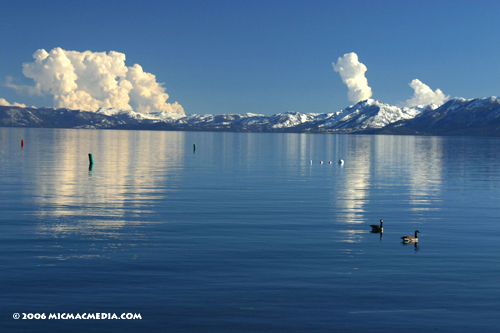
Photo #1: Cumulus clouds in early stage of
vertical development south of Lake Tahoe.
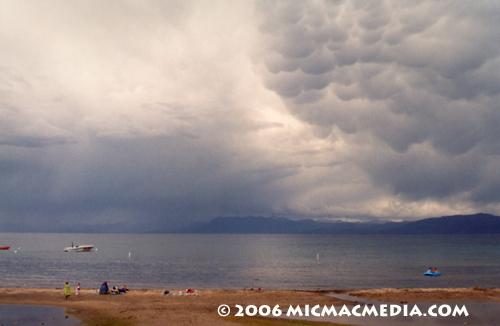
Photo #2: Rare mammatus clouds over Tahoe indicate a very moist and unstable atmosphere. Mammatus clouds indicate a vigorous thunderstorm in the region, but their
appearance usually follows the most active growth stage.
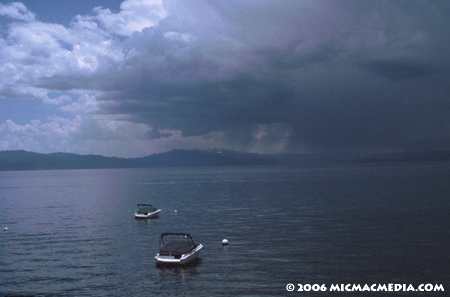
Photo #3: Summer thunderstorm approaching Lake Tahoe gives fair warning for boaters to head for land away from the storm.
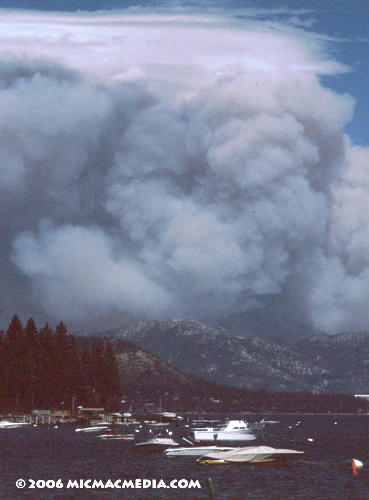
Photo #4: Humans and
lightning strikes are the main causes of summer forest fires. The July 2004 "Waterfall fire" near Carson City, Nevada, burned nearly 9,000 acres and destroyed 31 homes. Suppression cost close to $6
million, but no lives were lost.
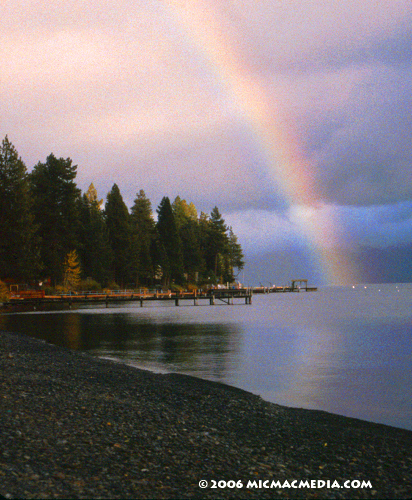
Photo #5: Rainbow in Carnelian Bay.
|